

In short
To qualify a PCB manufacturer in China, begin with your board and buying needs: layer count, material, copper, holes, impedance, finish, volume and acceptance criteria. Compare candidate sites against those requirements, review relevant process and quality information, then learn from a sample or pilot build before scaling. The best fit is a supplier that can explain how it will make and check your board.
Choosing a PCB manufacturer in China starts with the board you need to make, not a generic factory ranking. Put the construction, material, copper, drill, impedance, quantity and delivery needs into one brief. Then compare the candidate manufacturer and production site against that brief, using technical feedback and a sample build to test the fit.
Use this workflow to qualify a supplier against a defined product and site. Review PCB manufacturing services, then verify PCBArise's organization and resources in the company profile and the published scope on the certifications page. A qualification decision still belongs to the buyer and must reflect the buyer's product, contract and risk.
1. Describe the PCB you need to build
Begin with an application-neutral requirements sheet. Identify rigid, flex, rigid-flex, HDI, RF, power or another construction; current Gerber or intelligent data and drill revision; stackup and controlled features; surface finish; panel and quantity structure; and the inspection, test and records the buyer actually requires. Mark preliminary inputs as preliminary. A supplier cannot prove fit to an undefined build.
The Global Electronics Association's OEM guideline recommends making a capability checklist before searching and considering product construction, materials, technology and industry needs. That is a useful sequence, but its examples are not a substitute for a current project specification or a PCBArise capability promise.
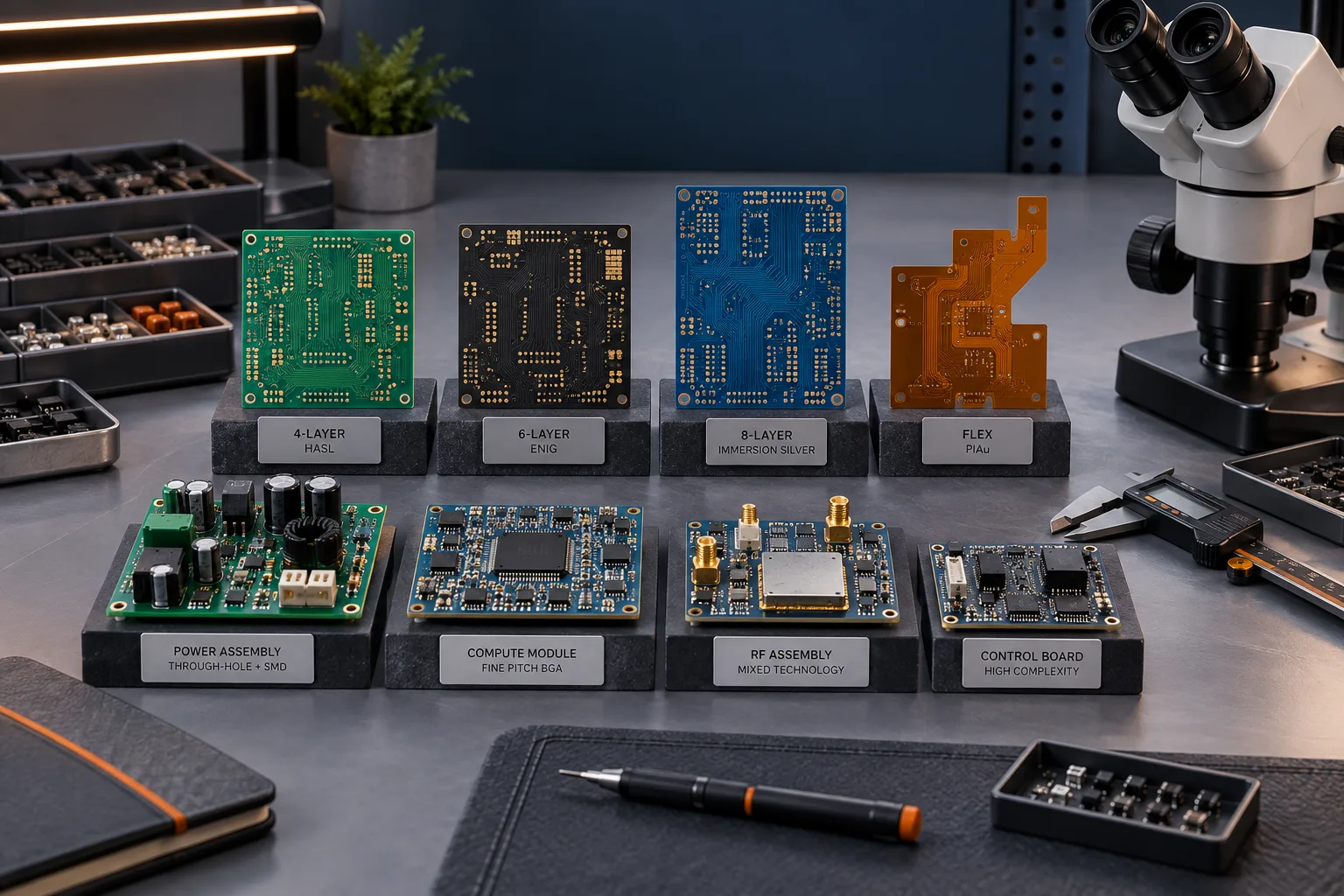
AI-generated illustration: Bare PCB and assembled board samples on a supplier evaluation desk.
2. Check the company, factory and process scope
Ask which legal entity receives the order, which location fabricates the board, and whether any material, special process, inspection or logistics activity is performed elsewhere. This is not an argument that one operating model is automatically better. It prevents a certificate, equipment list or sample result from being attributed to the wrong site or scope.
For each published certificate, verify the holder, address, issuing body, validity and scope relevant to the project. ISO's public supply-chain guidance distinguishes a supplier declaration, a buyer's second-party assessment and third-party certification; none removes the need to match the claim to the buyer's own requirements. Use the PCBArise certificate page as a starting point and request project-specific confirmation when needed.
| Qualification layer | Evidence to review | Decision question |
|---|---|---|
| Product fit | Released files, stackup, material, feature and quantity summary | Is the proposed route within a controlled, relevant process? |
| Organization and site | Legal entity, manufacturing address and outsourced-process boundary | Who performs and controls each operation? |
| Quality system | Applicable certificate holder, scope, validity and internal controls | Does the evidence apply to this site and activity? |
| Process and inspection | DFM route, traveler or control-plan examples, inspection/test proposal | How will critical requirements be built and verified? |
| Release control | Revision, deviation, approval and change-notification method | Can an unapproved assumption reach production? |
| Ongoing performance | Delivery, nonconformance, corrective-action and change review | What evidence keeps the approval current? |
3. Test capabilities against your stackup and features
A website capability table is a screening tool. Ask how the exact stackup, laminate, finished copper, hole structure, impedance target, finish and panel will be reviewed. For an unfamiliar or demanding feature, request evidence appropriate to the risk: a documented review, representative process record, coupon or cross-section plan, sample, pilot, or another agreed result. Do not demand every document for every low-risk order; do not accept an unrelated sample as proof of your construction.

AI-generated illustration: Engineers reviewing an electronics manufacturing process.
Equipment is evidence only when it connects to a controlled route, trained operation, maintenance or calibration where applicable, and a result. Likewise, a quality-system certificate does not state the limits of a particular PCB process. Use published manufacturing capabilities to frame questions, then let the released files and quotation establish the actual scope.
4. See how the supplier handles DFM questions and changes
Qualification should test how questions move between buyer and manufacturer. Send one controlled package and ask the supplier to list conflicts, assumptions, proposed deviations and missing approvals. Define who can approve stackup, material, finish, panel, tolerances or other changes. A fast answer is useful only if the answer is tied to the current revision and preserved in the release record.
Ask how a later process, material, site, tooling or sub-tier change would be communicated for the agreed scope. Define the buyer contact and the events that require re-review. The ISO 9001 Auditing Practices Group's public guidance highlights defined criteria, approved-provider information, verification, performance monitoring and risk-based control of external providers. Apply those principles proportionately rather than treating a one-time questionnaire as permanent qualification.
5. Learn from a sample or pilot build
A sample or pilot should answer open qualification questions. Identify the quantity, released revision, features under review, workmanship or performance criteria, inspection/test method, record format, failure disposition and approval authority before the build. A successful pilot supports the defined scope; it does not prove every future design or remove change control.
For a handoff into repeat production, use the prototype-to-production transfer checklist. PCBArise's quality-control page explains the available review framework, but the quotation and agreed documents define actual project coverage.
A practical PCB supplier selection path

AI-generated illustration: Pilot PCBA batch undergoing inspection at a workcell.
- Freeze the product, stage, quantity, acceptance and destination baseline.
- Screen the named entity, site, construction and process boundary.
- Verify certificate scope, process controls, DFM communication and relevant evidence.
- Run a pilot or sample review against stated acceptance criteria where the risk requires it.
- Approve, conditionally approve or reject a named scope; record deviations and owners.
- Monitor delivery, quality, corrective action and changes, then re-evaluate when triggers occur.
Printable PCB manufacturer qualification checklist
- □ One current file manifest, revision, construction, quantity and product stage are identified.
- □ Legal entity, order recipient, manufacturing site and sub-tier process boundaries are known.
- □ Certificate holder, site, scope, issuer and validity have been checked where relevant.
- □ Capability claims are matched to the exact stackup, material, features and proposed route.
- □ DFM questions, assumptions, deviations and approval authority are controlled.
- □ Inspection, test, sample or pilot evidence is defined by feature and acceptance need.
- □ Change-notification and nonconformance escalation paths are agreed.
- □ Approval states the covered products, sites, processes, conditions and re-evaluation triggers.
Print or save this page as PDF for a supplier review meeting. It is a buyer checklist, not certification of any supplier. When a project package is ready, submit it through the project review page so PCBArise can confirm the applicable route and quotation scope.
FAQ
Common questions
What is the first step in qualifying a PCB manufacturer in China?+
Freeze the actual build and buying requirements: revision, construction, material, critical features, quantity, stage, acceptance evidence, destination and applicable constraints. Qualification without a defined scope only evaluates marketing claims.
Does ISO 9001 certification prove a supplier can build my PCB?+
No. It provides quality-management-system evidence for the stated holder, site and scope. Buyers still need to confirm that the proposed process fits their board and that project requirements, acceptance and changes are controlled.
Should every PCB supplier receive an on-site audit?+
Not automatically. Choose the depth of verification from product risk, customer or regulatory obligations, process novelty and available evidence. A document review, remote review, representative evidence, sample, pilot or site audit can serve different purposes.
What should a PCB supplier pilot prove?+
It should answer named open questions against one released revision, such as manufacturability, a critical feature, inspection evidence or test result. Define criteria and records before the pilot; passing it does not approve unrelated products or future changes.
How do I verify a PCB manufacturer's capability claim?+
Match the claim to the exact construction and site, ask how the feature is reviewed and controlled, and request proportionate evidence tied to a representative or pilot build. Do not infer project acceptance from an equipment list alone.
When should a qualified PCB supplier be re-evaluated?+
Use agreed triggers such as a material, process, site, sub-tier, tooling or quality-system change; repeated delivery or quality issues; a major new product requirement; or expiry of relevant evidence. The buyer should define the interval or trigger policy.
Technical references
Sources used for this guide
These sources explain the standards, materials or process details discussed above. Check the current revision when applying them to a new design.
- Global Electronics Association — OEM guideline to selecting and qualifying PCB suppliers
- ISO — ways buyers can establish confidence in a supplier's ISO 9001 claim
- ISO 9001 Auditing Practices Group — external-provider controls and performance monitoring
- ASC — professional PCB supplier evaluation checklist and evidence gaps
- Lead PCB — professional supplier qualification workflow comparison
- QueenEMS — professional project-fit and quote-assumption review
- Global Electronics Association — current demand context; not a supplier capacity forecast