

In short
A useful PCB quote comparison puts each supplier against the same board revision, quantity and delivery destination. Compare the included fabrication construction, component sourcing, assembly, inspection and testing, then separate tooling or setup from recurring price. Resolve exclusions and assumptions before ranking the total so the offers describe the same build.
PCB and PCBA quotations are easier to compare when every supplier prices the same design package and scope. Start with one revision and quantity break, then line up fabrication, components, assembly, test, one-time charges and logistics. A simple side-by-side sheet makes missing or optional work visible before price becomes the deciding factor.
Use this checklist to normalize the scope of returned quotations. Submit a project through the PCBArise quote page, and use the PCB cost-drivers guide to understand why fabrication prices change. The comparison below checks whether competing totals represent the same scope; it does not predict price.
Send the same files and quantity to every supplier
Give every bid a comparison ID and record the assembly or board part number, revision, variant, fabrication dataset, BOM and placement revision, requested quantity and breaks, prototype or production stage, destination and requested delivery context. If a supplier quoted an earlier file set or a different quantity, do not silently adjust the unit price; mark the bid non-comparable until it is requoted or the deviation is accepted.
Siemens describes data standardization and discrepancy identification as major challenges in PCB sourcing and quotation work. A simple controlled matrix can solve the buyer-side version of that problem: one baseline across every column and a visible exception whenever an offer departs from it.
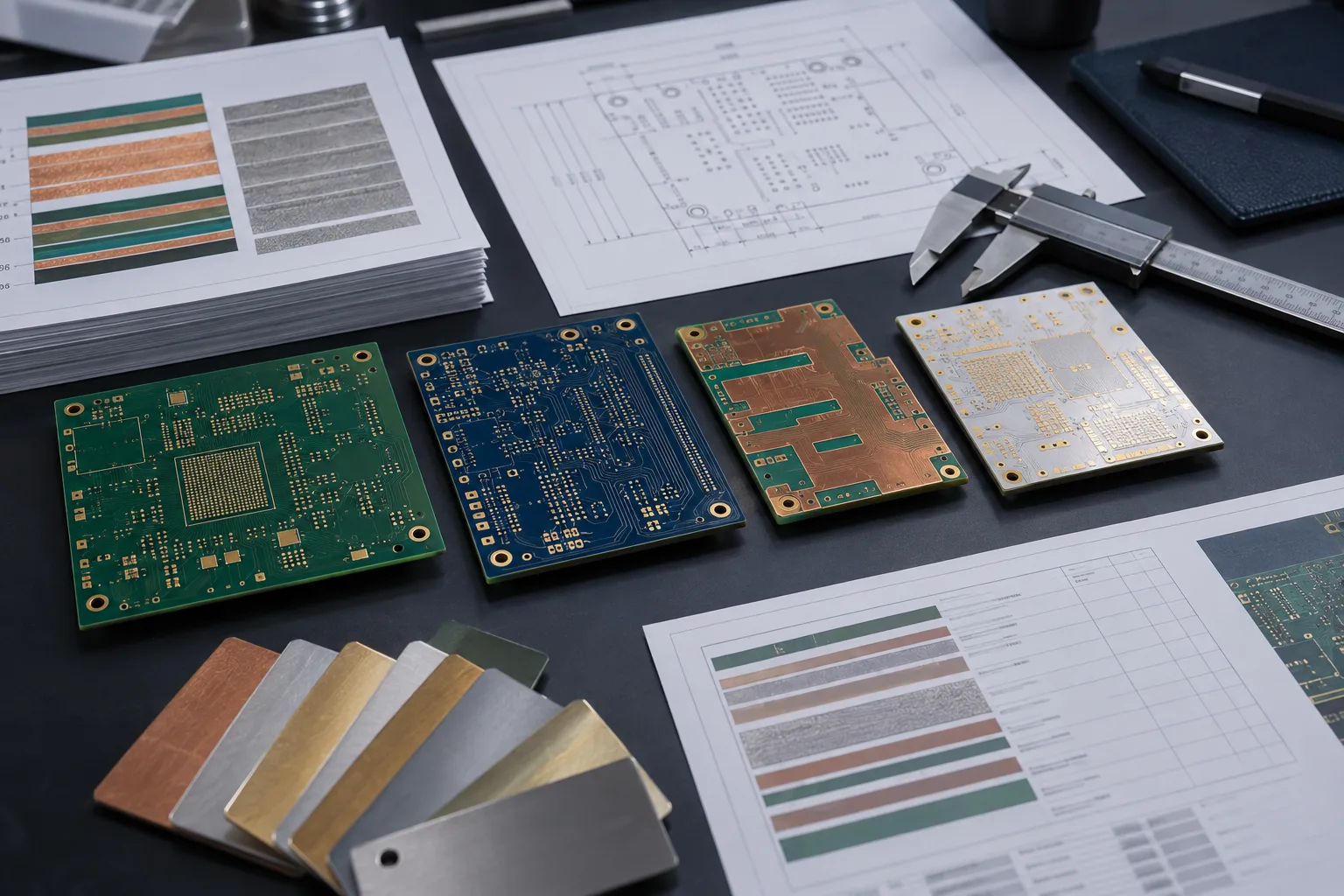
AI-generated illustration: PCB samples and fabrication drawings prepared for quote comparison.
Compare what each PCB quote actually includes
| Comparison row | Normalize these items | Common hidden difference |
|---|---|---|
| Board and revision | Part, revision, stackup/material, finish, panel and quantity | Preliminary stackup or different panel basis |
| Components | BOM revision, MPNs, sourcing model, alternates, excess and attrition | Shortages, substitutions or minimum buys excluded |
| Assembly and special work | SMT/THT sides, odd-form, programming, cleaning, coating or integration | Special operation priced as optional or omitted |
| Inspection and test | Method, unit/lot scope, fixture/program, criteria, record and retest | Method named without coverage or deliverable |
| NRE and tooling | Setup, stencil, pallet, fixture, program, ownership and reuse basis | One-time charges embedded in unit price |
| Schedule | Start event, material assumptions, approvals and delivery milestone | Lead time starts after an unstated approval or material gate |
| Commercial and logistics | Currency, validity, payment, packaging, freight, term/place/version | Ex-works total compared with delivered total |
For PCB fabrication, confirm material and stackup, finished copper, hole and tolerance assumptions, controlled impedance, electrical test, coupon or record needs, panelization and surface finish. For PCBA, add BOM sourcing responsibility, customer-supplied material handling, variants and DNPs, placement, programming, soldering branches, inspection, functional requirements, packaging and any box-build boundary.
A complete file set helps comparison but does not make every service automatic. Use BOM preparation guidance for orderable component data and the turnkey versus consigned guide to fix purchasing responsibility before comparing offers.
Compare inspection and test coverage
Terms such as electrical test, AOI, X-ray, ICT and functional test are not equivalent coverage statements. Record the feature or behavior to be checked, which units or lots are covered, fixture and program responsibility, inputs and limits, acceptance authority, output record, failure disposition and retest rule. If one bidder includes a method and another excludes it, the totals do not describe the same quality scope.
The quality-control page and project quotation can frame PCBArise's applicable route. They do not establish a fixed default test package. The buyer must state the product requirement, and the returned offer must say what evidence is actually included.

AI-generated illustration: PCB assembly test fixtures considered in a quote scope.
Separate unit cost from tooling and setup
List bare-board unit cost, component cost, assembly labor and recurring special-process cost separately when the supplier provides that breakdown. Then list engineering setup, stencil, pallet, programming, test fixture or other non-recurring engineering charges. Record whether a charge applies once, per revision, per lot or under another stated condition, and who owns, stores, maintains and can reuse the tooling. Do not invent an amortization threshold; compare the supplier's stated basis at the quantities you actually intend to buy.
Compare lead-time start points and change rules
A quoted lead time needs a start event and end milestone. Does it begin at purchase order, approved files, engineering-question closure, complete material, payment, first-article approval or another gate? Does it end at factory completion, carrier handoff or arrival? Record material availability, buyer approvals and split-shipment assumptions beside the duration. Current industry demand or component sentiment can inform questions, but it cannot prove a project-specific price or schedule.
Also state what triggers a requote: quantity, revision, material, BOM alternate, test scope, tooling, currency, freight, destination or validity period. A supplier should not be expected to hold a price after the priced baseline changes, and a buyer should not accept an unapproved technical deviation simply to preserve the original total.
Compare logistics and commercial terms on the same basis
Record currency, tax or duty treatment, payment schedule, quotation validity, packaging, shipping method, insurance responsibility and destination. When an Incoterms rule is used, the International Chamber of Commerce recommends identifying the chosen rule, named port/place/point and the applicable Incoterms version. The named place matters because cost, carriage, delivery and risk responsibilities differ by rule. This checklist is operational guidance, not legal or tax advice; the buyer should obtain appropriate advice for its contract and jurisdiction.
How to compare PCB quotes side by side

AI-generated illustration: Buyer and engineer comparing PCB quotation packages.
- Lock the source files, revision, quantities, acceptance needs and delivery basis.
- Enter every returned quote into the same inclusion, exclusion and assumption matrix.
- Separate recurring, NRE, tooling, material, test, packaging and logistics costs.
- Normalize schedule start/end points, currency, payment and delivery responsibility.
- Return deviations and open questions to each bidder; record approved exceptions.
- Award against the resolved baseline and define what changes require approval or requote.
Printable PCB quote comparison checklist
- □ Every bid references the same part, revision, variant, files and quantity breaks.
- □ Board construction, material, finish, panel and electrical-test scope match.
- □ BOM revision, exact MPNs, sourcing model, alternates, excess and supplied material are visible.
- □ Assembly, special processes, programming, inspection, test, records and acceptance are itemized.
- □ Recurring price is separated from NRE, stencil, pallet, fixture and program charges.
- □ Tooling ownership, storage, maintenance, reuse and revision conditions are stated.
- □ Schedule start point, approval gates, material assumptions and delivery milestone match.
- □ Currency, validity, payment, packaging, freight and trade term/place/version are comparable.
- □ Every deviation, exclusion and unresolved assumption has an owner and disposition.
Print or save this page as PDF and keep the completed matrix with the sourcing decision. To obtain a project-specific PCBArise response, send the controlled package through Get a Quote. The returned quotation and agreed documents—not this checklist—define the actual scope, price, schedule and commercial terms.
FAQ
Common questions
How should I compare PCB quotes from different manufacturers?+
Lock one revision and quantity baseline, then compare inclusions, exclusions and assumptions for fabrication, components, assembly, inspection, test, NRE, tooling, schedule, packaging, freight and commercial terms before ranking totals.
Why can the lowest PCB unit price cost more overall?+
The unit price may exclude tooling, testing, components, special processes, packaging, freight, duties or minimum-buy material included elsewhere. Normalize the complete stated scope and responsibility boundary rather than adding unsupported estimates.
What test details belong in a PCB quote comparison?+
Record the method, feature or behavior checked, unit or lot coverage, fixture and program responsibility, limits, acceptance owner, result record, failure disposition and retest rule. A test name alone does not define coverage.
How should NRE and tooling be compared?+
Separate them from recurring price and state when each charge applies. Confirm ownership, storage, maintenance, reuse, transfer and the design or process changes that require new tooling or programming.
What does lead time mean on a PCB quotation?+
Lead time is the elapsed time between the quote's named start and finish milestones. For example, a fabrication lead time may run from approved production files to finished-board dispatch; it does not automatically include DFM clarification, component procurement, assembly or transit. Write both milestones and any approval or material hold into the comparison table.
Which commercial terms should appear in the comparison?+
At minimum compare currency, quotation validity, payment schedule, taxes or duties where stated, packaging, freight, insurance responsibility, destination and any chosen Incoterms rule with named place and version. Seek legal or tax advice when needed.
Technical references
Sources used for this guide
These sources explain the standards, materials or process details discussed above. Check the current revision when applying them to a new design.
- Siemens — data standardization and discrepancy challenges in PCB sourcing and quoting
- International Chamber of Commerce — stating the chosen Incoterms rule, named place and 2020 version
- Global Electronics Association — product capability and supplier qualification inputs
- HLCPCB — professional PCB and PCBA quote-file checklist comparison
- Faradine — professional PCBA RFQ input checklist
- SupplyForge — professional manufacturing quote normalization framework
- ECIA — current component-market sentiment context; not a project price or lead-time promise