Quantity and cadence
Review monthly demand, release cadence, panel strategy and the production horizon before reserving a route.
Scaling PCBA beyond the pilot run takes more than placement capacity. PCBArise plans repeat orders around component supply, line fit, inspection and testing, traceability and a clear way to manage design or material changes.
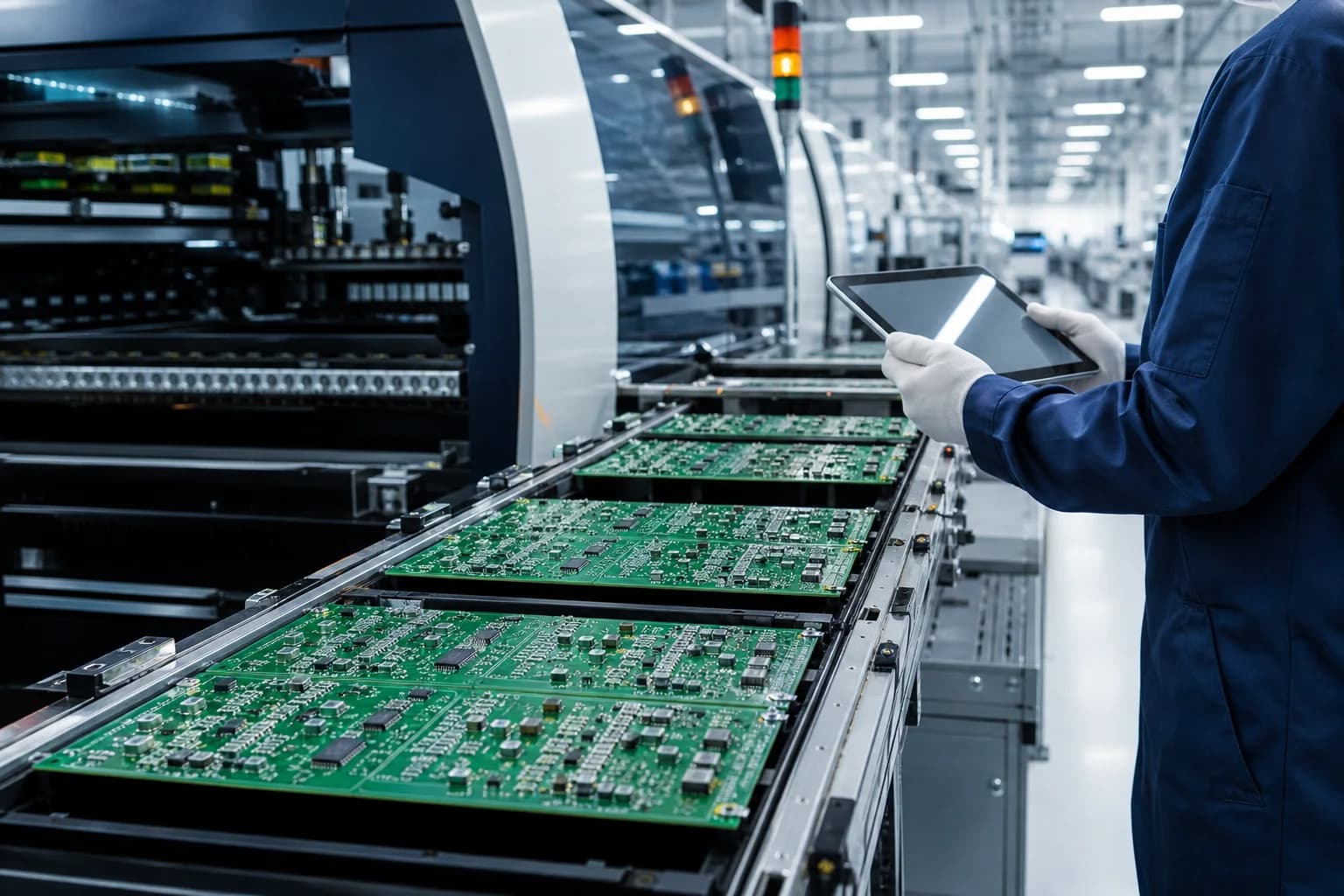
High-volume PCB assembly is repeat production at a scale where line balance, material continuity, yield, traceability and controlled change management matter as much as placement speed. The route starts with an approved build baseline and a production plan that can be measured over time.
A high-volume PCBA route depends on material availability, balanced operations, stable fixtures, inspection evidence and a change process that protects the released baseline.
Review monthly demand, release cadence, panel strategy and the production horizon before reserving a route.
Control manufacturer parts, alternates, lifecycle, consigned material and shortage response across repeat orders.
Carry stencil, placement, reflow, soldering, inspection, programming and test settings into the released baseline.
Measure yield, defects, rework, test results and approved changes so scale does not hide a recurring issue.
These rows frame the production questions that must be closed before a high-volume PCBA route is approved.
Capacity, schedule and line allocation remain subject to the released files, demand plan, material availability and project-specific review.
| Production demand | Quantity, cadence, launch date, ramp plan and expected repeat horizon |
|---|---|
| Released baseline | Gerber or ODB++, BOM, CPL, assembly drawing, firmware and test revision aligned |
| Material continuity | Approved sources, alternates, lifecycle, consigned parts and shortage escalation documented |
| Line fit | Package mix, board size, panelization, placement, soldering and secondary operations reviewed |
| Process controls | Stencil, placement, reflow, wave or selective solder, programming and fixture settings controlled |
| Inspection and test | SPI, AOI, AXI, ICT, flying probe or FCT assigned to product and process risks |
| Traceability | Component lot, panel, revision, process and test evidence retained to the agreed level |
| Change management | Engineering changes, deviations, nonconformance and requalification triggers defined before release |
A line can place components quickly and still miss the production objective if a part goes obsolete, a revision changes without control, a fixture is not ready or the inspection evidence cannot be tied back to the build.
The review converts demand into a production plan that can be monitored, repeated and changed under control.
Choose high-volume assembly when a released product needs repeatability, supply continuity and measurable production evidence over recurring orders.
Repeat assemblies with stable package libraries, controlled sourcing and defined test coverage.
Recurring control boards where revision, lot and field-return traceability matter.
Production routes that need material, process, inspection and change controls aligned to the approved build.
Quality documents
The published ISO records name Zhongshan Wenquan Electronic Manufacturing Co., Ltd. and its Zhongshan PCBA facility. They do not certify every PCBArise facility, service or product.
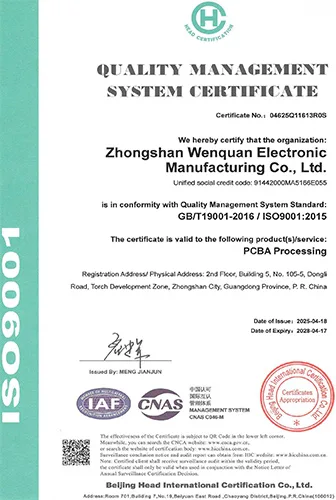
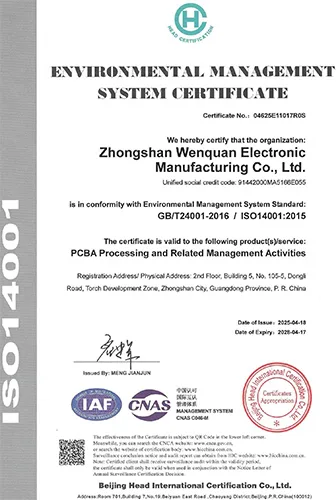
These are management-system certificates, not product or batch COAs. No batch inspection reports or COAs are currently published here.
These high-volume PCB assembly answers focus on capacity fit, continuity, traceability and controlled production change.
High-volume PCB assembly includes a released SMT, THT or mixed-technology process route supported by material planning, line setup, inspection, testing, traceability and controlled change management.
Engineering reviews demand, board and panel format, package mix, line and soldering route, material availability, fixture needs, inspection, test and the required production evidence.
A consigned or partial-turnkey route can be reviewed. The quote must define quantity, condition, traceability, shortage, attrition and approval responsibility before production.
Changes are reviewed against the released design, BOM, process, fixture, test and qualification requirements. The applicable approval and requalification steps are agreed before the changed build is released.
Move from low-volume learning and turnkey sourcing to high-volume process, testing and quality evidence through the Assembly routes.
Share the released package, monthly demand, launch plan, material rules, test requirements and traceability expectations for a high-volume PCBA review.