In short
Low-volume PCB assembly supports prototypes, pilots and smaller or changing release patterns. Higher-volume production benefits from stable files, component supply, tooling, process settings and test methods that can be repeated. Choose the route by the product stage and demand pattern, then discuss panelization, sourcing and test setup with the manufacturer.
Low-volume and high-volume PCB assembly differ in more than order size. An early product needs flexibility to learn from a pilot; a repeat build benefits from stable sourcing, tooling and process settings. Compare the product stage, forecast, BOM stability and test needs to choose a manufacturing route that fits how the program will run.
Compare the route here, then continue to low-volume PCB assembly for pilot and small-batch enquiries or high-volume PCB assembly for repeat-production enquiries. Use the prototype-to-production checklist for the detailed transfer of an approved build. No quantity, price, lead-time or test threshold on this page replaces a project quotation.
Which PCB assembly route fits your product?
Choose a low-volume route when the build still needs learning, frequent revision changes, flexible sourcing or process confirmation. Choose a high-volume route when demand is repeatable and the released design, BOM, panel, programs, tooling, acceptance evidence and change rules are controlled. If those conditions are mixed, use a pilot or staged release and define the evidence needed before the next route decision.

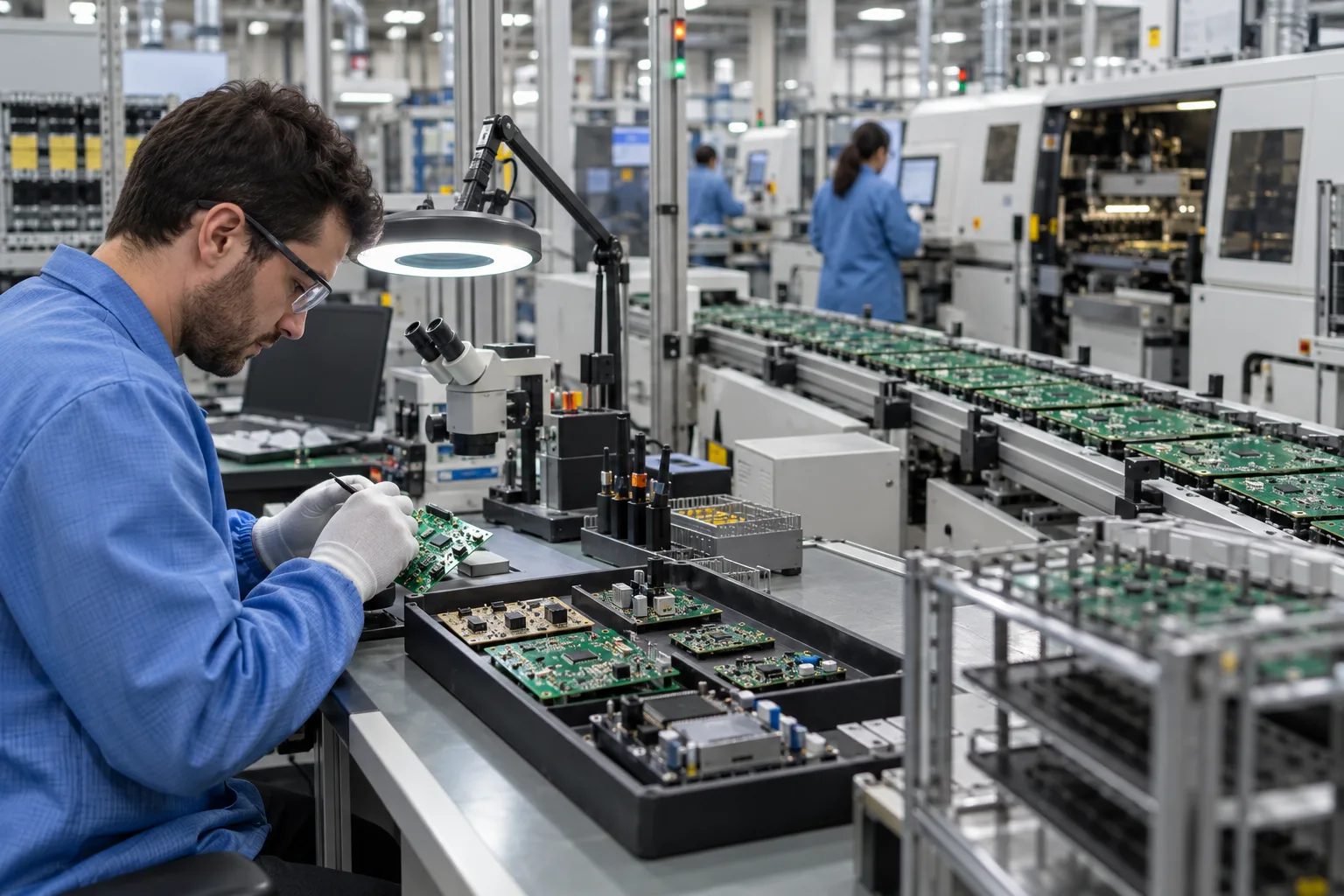
AI-generated illustration: Small-batch PCBA prototype assembly workcell.
Six factors beyond the order quantity
| Decision input | Low-volume route is useful when | Repeat-production route needs |
|---|---|---|
| Release maturity | Engineering questions or validation actions remain open | One approved fabrication, assembly, firmware and test baseline |
| Demand pattern | Forecast, variants or release cadence can still change | A planning horizon and shipment pattern the parties can review |
| BOM stability | Sources, alternates or lifecycle risks need evaluation | Approved parts, alternates, ownership and shortage escalation |
| Change frequency | Learning is expected between controlled builds | Changes enter only through an agreed approval and effective-revision process |
| Process readiness | Panel, stencil, programs, fixtures or work instructions need confirmation | Production-intent settings and controls are released and maintainable |
| Acceptance evidence | A pilot must close named inspection or test questions | The required method, scope, criteria, record and disposition are repeatable |
NIST manufacturing-readiness material separates prototype work, production-representative demonstration, pilot capability and full-rate production. That principle is more useful than copying a supplier's quantity label: readiness has several dimensions, including materials, process and production evidence. Your contract manufacturer still needs the actual PCBA package and demand plan before assigning a route.
What a low-volume PCB assembly route is for
Low volume is appropriate when flexibility and evidence gathering are part of the build objective. An NPI team may need to verify component orientation, thermal behavior, programming, fixture access or a functional sequence. A technical buyer may need a controlled field batch without committing to a recurring schedule. A mature industrial product may stay low-volume because demand is naturally limited, even though its files and controls are stable.
A low-volume route is not permission to use uncontrolled files. Give the manufacturer one revision identifier, a reconciled BOM and placement set, assembly drawings, approved deviations and the validation questions for that build. Identify which results must be captured for the next release. The PCB assembly overview shows how technology, sourcing boundary and acceptance planning connect.
What changes in a high-volume or repeat-production route
Repeat production shifts attention from one successful build to continuity. Material availability, line and panel fit, setup retention, work instructions, inspection/test programs, traceability, packaging and change notification must remain aligned over later releases. Automation can support that objective, but equipment speed alone does not prove that a product is ready or that a supplier is the right fit.
Process data also needs context. The IPC-9191 guidance describes process-control tools as selectable according to the operation, customer and production characteristics; it does not prescribe one identical control plan for every assembly. Similarly, IPC-1782 presents traceability levels as a user-and-supplier agreement. Define what the program needs rather than assuming a fixed evidence bundle accompanies every high-volume order.
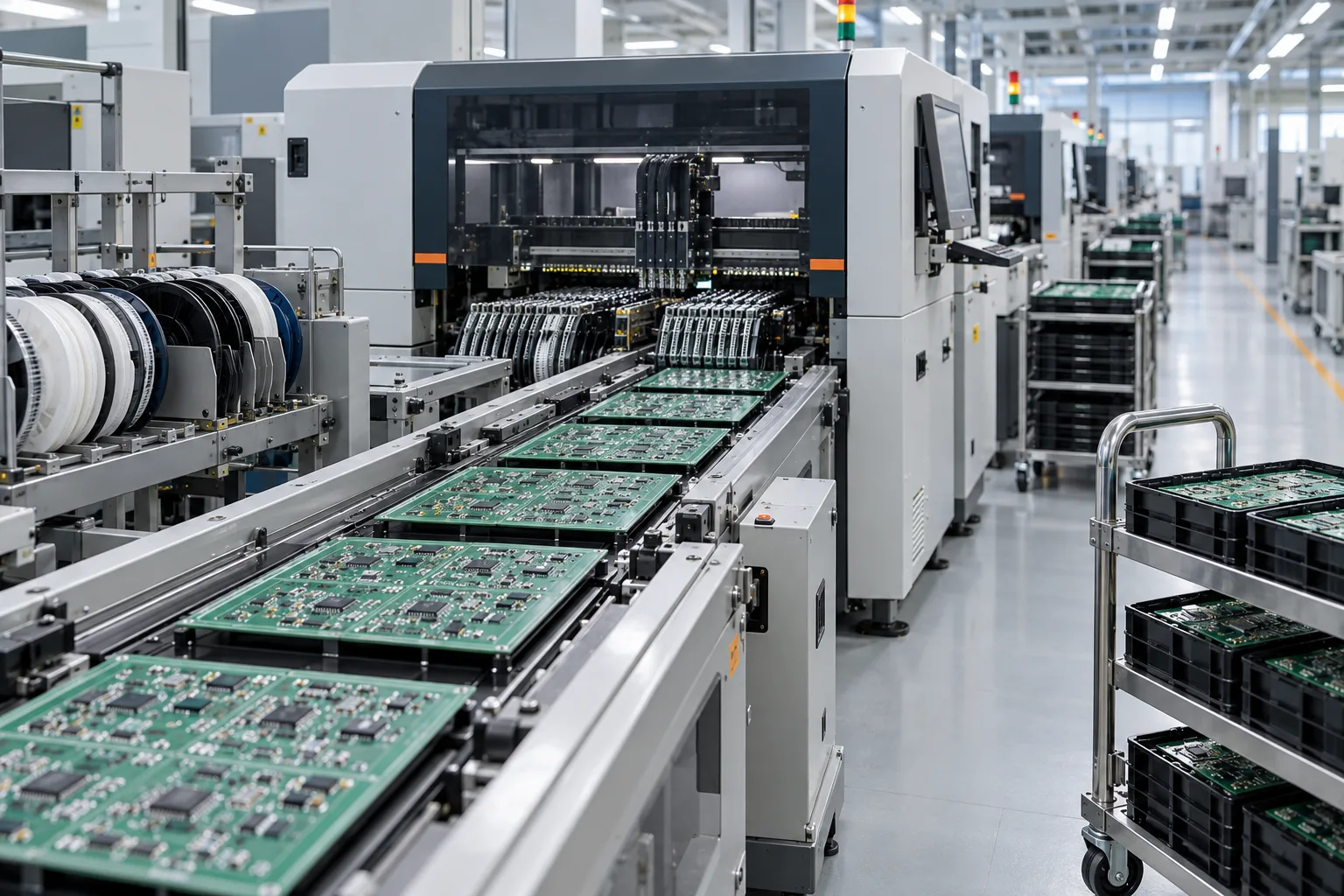
AI-generated illustration: Repeat-production SMT line assembling PCB panels.
Do not confuse volume, mix and maturity
Volume describes workload over a stated period. Mix describes how many products or variants share the manufacturing environment. Maturity describes how stable and proven the design and production system are. A high-mix, low-volume program can require rigorous revision and setup control because frequent changeovers create risk. A high-volume product can still be immature if files, sources or tests are changing during ramp.
Ask the supplier to translate annual or monthly demand into the real workload: board and panel format, placements, variants, changeovers, secondary operations, programming, test time, material constraints and delivery cadence. This produces a route discussion without pretending that one board-count threshold applies to every product.
What to settle before repeat production
- One approved file manifest links fabrication, BOM, placement, drawings, firmware and test revision.
- Material ownership, approved manufacturer parts, alternates and shortage decisions are visible.
- The panel, stencil, placement, soldering, cleaning or coating, programming and test route is defined where applicable.
- Pilot issues, rework and deviations have owners and documented dispositions.
- Inspection and test identify the question, coverage, criteria, result format and failure path.
- Traceability, labeling, packaging and record delivery match the buyer's actual requirement.
- Engineering and supplier changes have approval, effective-date or lot, and re-review rules.
The PCB assembly traceability guide helps define lots, revisions and records without assuming every order receives the same data package.
Choose a route from product stage to demand plan

AI-generated illustration: Engineer planning prototype and repeat PCBA production routes.
- Define product stage, release quantity, cadence, variants and destination.
- Review the released files, BOM stability, material ownership and open engineering questions.
- Identify panel, tooling, programming, inspection, test and record readiness.
- Select the route that balances controlled learning with repeatability for this release.
- State the acceptance evidence and changes that trigger another review.
- Preserve the approved baseline, results and dispositions for the next order.
What to send for a PCB assembly quote
Send the current Gerber or ODB++ package, NC drill, BOM with manufacturer part numbers, placement data, assembly drawings, quantity and expected release pattern. Add product stage, variants, sourcing ownership, programming, inspection and test requirements, record needs, packaging, destination and open questions. PCBArise can then review whether a pilot, low-volume or repeat-production route fits the released scope through Get a Quote.
FAQ
Common questions
What is the difference between low-volume and high-volume PCB assembly?+
Low-volume assembly emphasizes flexibility, controlled learning and smaller or variable releases. High-volume or repeat-production assembly emphasizes a stable released baseline, material continuity, repeatable process controls and managed changes. The dividing quantity depends on the product and supplier route.
Is there a standard quantity that makes PCB assembly high volume?+
No fixed board count separates the two. A repeat order becomes a production-route candidate when the design and BOM are stable, demand is predictable, material can be planned and the setup or tooling cost is recovered over the expected releases. Compare annual demand and lot size, placement count, test time and change frequency; a large one-off batch can still behave like an NPI build.
When should an NPI team remain on a low-volume route?+
Remain on a staged or low-volume route while design, BOM, process, tooling, program, test or demand questions still require learning between controlled builds. Define the evidence that will close each question.
Does moving to high volume automatically reduce unit price or lead time?+
No. Price and schedule depend on the quoted scope, materials, tooling, workload, approvals, production plan and commercial terms. Only a current quotation can establish them for the project.
Should low-volume and high-volume builds use the same test plan?+
Not automatically. The product requirement and failure risks define the inspection and test plan. A pilot may establish a method; repeat production needs the agreed program, limits, coverage, records and change controls.
What files are needed to choose a PCB assembly route?+
Provide the current board data, drill data, BOM, placement data, assembly drawings, quantity and cadence, sourcing responsibility, programming and test needs, acceptance evidence, packaging and the open engineering decisions.
Technical references
Sources used for this guide
These sources explain the standards, materials or process details discussed above. Check the current revision when applying them to a new design.
- NIST — manufacturing readiness levels distinguish prototypes, pilot capability and production-rate readiness
- NIST — prepare product design for production through process, system and sequence definition
- Global Electronics Association — process-control elements are selected for the process and customer need
- Global Electronics Association — IPC-1782 traceability scope is agreed between user and supplier
- Technotronix — professional comparison of low- and high-volume PCBA decisions
- Z-AXIS — professional explanation of volume, product mix and placement workload
- i-TECH e-Services — professional high-mix, low-volume process overview