

In short
Prepare SMT material by exact manufacturer part number, BOM line, quantity, lot, package and polarity—not by carrier name alone. Full reels, trays and tubes can support organized machine loading, while cut tape needs continuity, intact pockets and an agreed feeder route. Record loose parts, shortages, mixed lots, alternates and uncertain labels separately; carrier orientation never replaces the CPL rotation definition.
- Packaging format is a delivery and feeding choice, not a component quality grade.
- Verify exact MPN, BOM line, package, lot, count and polarity/orientation before material reaches setup.
- For cut tape, record strip count, continuity, pocket condition and the actual feeder or transfer plan.
- Separate shortages, loose parts, mixed lots, alternates and unidentified material instead of hiding them in one kit total.
Prepare each SMT item as a traceable material unit that the receiving and setup teams can identify, count and feed without guessing. Match manufacturer part number, BOM line, quantity, lot, package and polarity/orientation first. Then record whether it arrives as a reel, tray, tube or cut tape, its physical condition and the intended loading route. Separate shortages, loose parts, mixed lots, substitutes and unclear labels before the kit reaches the machine.
When should SMT components arrive on reels, trays, tubes or cut tape?
Choose the form that protects the package and supports the planned loading method and quantity. Tape and reel gives a continuous indexed carrier for compatible feeders. Trays organize larger or package-sensitive devices in fixed pockets. Tubes keep compatible leaded packages in sequence for a tube feeder or controlled transfer. Cut tape is useful for small quantities but may need extra preparation because it can arrive as one or more short strips.
| Format | Useful delivery situation | Preparation checks | Do not assume |
|---|---|---|---|
| Full or partial reel | Continuous carrier for an identified orderable part and a compatible feeder plan. | Reel/label identity, tape width and pitch where needed, pocket condition, quantity, direction and usable start/end. | Every reel fits every feeder or includes the line's required leader and remaining quantity. |
| Tray | Packages supplied in protected matrix pockets and handled by a tray loading route. | Tray type, package/pocket fit, cover/stack condition, quantity, chamfer or orientation cue and empty-pocket map. | The tray is bakeable, machine-compatible or interchangeable with another vendor's tray. |
| Tube | Compatible packages kept in a linear sequence for tube feeding or controlled transfer. | Tube label, end stops, part count, package direction, damage and the planned loading or conversion method. | Part direction survived an opened tube or that a tube suffix describes the same orderable packaging as a reel suffix. |
| Cut tape | Prototype or low-quantity supply taken from a manufacturer reel. | Continuous strip quantity, pocket and cover integrity, sprocket holes, direction, leader/tail condition and feeder plan. | A short strip can be mounted directly or that all ordered pieces arrive on one continuous strip. |
Packaging form is not an electrical, authenticity or quality grade. The same device family may have different orderable suffixes for reel, tray or tube; conversely, two similar-looking carriers can hold different packages or orientations. Use the exact manufacturer order code and packaging document.
What identity and count information must be checked before kitting?
Reconcile every physical container to one BOM line and one exact orderable part before counting it as available. Check manufacturer, full manufacturer part number, package/order suffix, BOM line and reference range, required and supplied quantity, lot/date information provided, packaging label, component marking where practical, and polarity or pin-one definition. Record partial containers and already-opened packaging explicitly.

| Field | Physical evidence | BOM/setup cross-check | Difference to record |
|---|---|---|---|
| Orderable identity | Manufacturer label and part/package suffix. | Exact MPN and approved source on the released BOM. | Missing suffix, alternate manufacturer or conflicting package. |
| Quantity | Full-pack quantity, supplier count, open-container count or verified estimate method. | Required placements, build quantity and agreed setup allowance. | Shortage, overage, uncertain loose count or unusable pockets. |
| Traceability | Lot/date and distributor/source information supplied with the container. | Project's required material record. | Mixed lots, detached label or missing source link. |
| Package and polarity | Package marking, pin-one/polarity cue and carrier orientation. | Datasheet/package drawing, BOM package and assembly drawing. | Ambiguous mark, reversed strip, wrong package or unresolved direction. |
| Special handling | MSL/ESD or process-sensitive labels where applicable. | Handling route and line-side exposure record. | Damaged dry pack or unknown exposure, handled under the dedicated moisture procedure. |
Why do cut-tape continuity, pockets, leaders and splices affect loading?
The feeder must index the carrier, peel the cover tape and present each usable pocket consistently before the first placed component. A very short strip, damaged sprocket holes, torn cover tape, bent pockets or a poorly aligned splice can prevent threading or create a pick interruption. Empty leader and trailing material may be needed for a particular loading method, but the required length and minimum quantity depend on the actual feeder, carrier and setup—not on one universal number.
Before release, state whether the material is one continuous strip or several fragments, how many usable pockets each strip contains, whether the cover is intact, where any splice sits, and whether the planned equipment accepts that form. If conversion to a custom reel or another carrier is planned, preserve identity, lot and orientation through the transfer and record any components lost or quarantined.
How should reel, tray and tube orientation be handed to SMT programming?
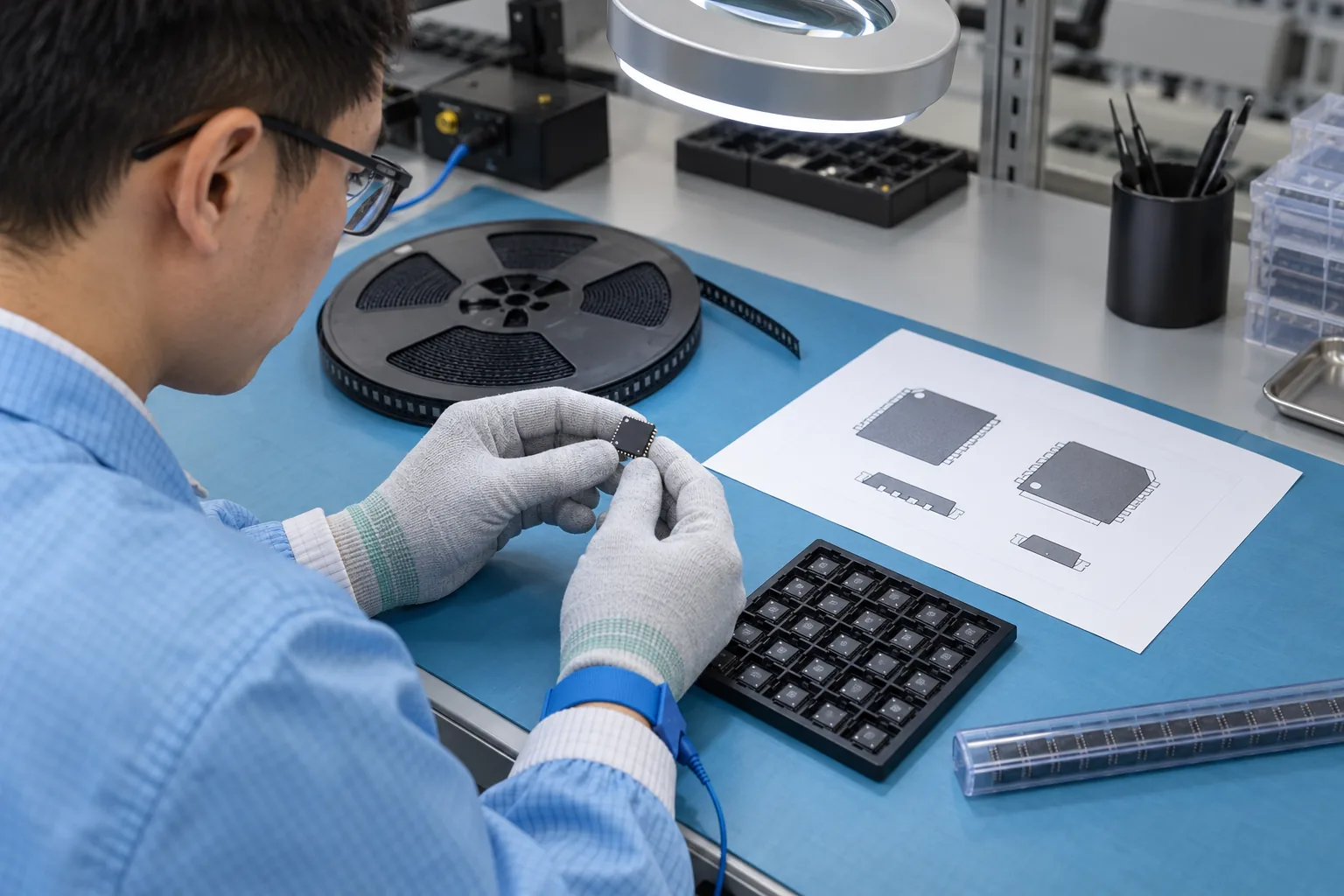
Record carrier orientation as a physical packaging fact, then derive placement rotation separately from the package library, footprint and CPL convention. Reel pin-one quadrant, tray chamfer and tube loading direction tell the setup team how the component is presented. CPL rotation tells the machine how the part must be placed on a specific PCB side under a stated coordinate convention. They are related inputs, not interchangeable numbers.
| Source | Defines | Used by | Failure if confused |
|---|---|---|---|
| Manufacturer packaging drawing | Pin-one/polarity presentation in reel, tray or tube. | Receiving, feeder setup and transfer work. | Material may be loaded reversed or transferred without a reliable cue. |
| Component/package drawing | Physical terminal, pin-one and body orientation. | Library and footprint verification. | A carrier cue is mapped to the wrong package terminal. |
| PCB footprint and assembly drawing | Required component orientation on the board. | NPI and first-article inspection. | The programmed placement follows the carrier but not the PCB design. |
| CPL/centroid convention | Board side, origin, coordinates and rotation notation. | Placement-program generation. | A correct physical orientation receives the wrong numeric rotation. |
How should shortages, loose parts, mixed lots and alternates be handled?
Give each discrepancy its own quantity, identity and disposition instead of adjusting the kit total silently. Keep loose components in suitable protective packaging with a linked label; segregate unknown or mixed material; state the shortage against the affected BOM line; keep approved alternates under their own MPN and authorization; and preserve partial-reel identity when surplus returns from the line.
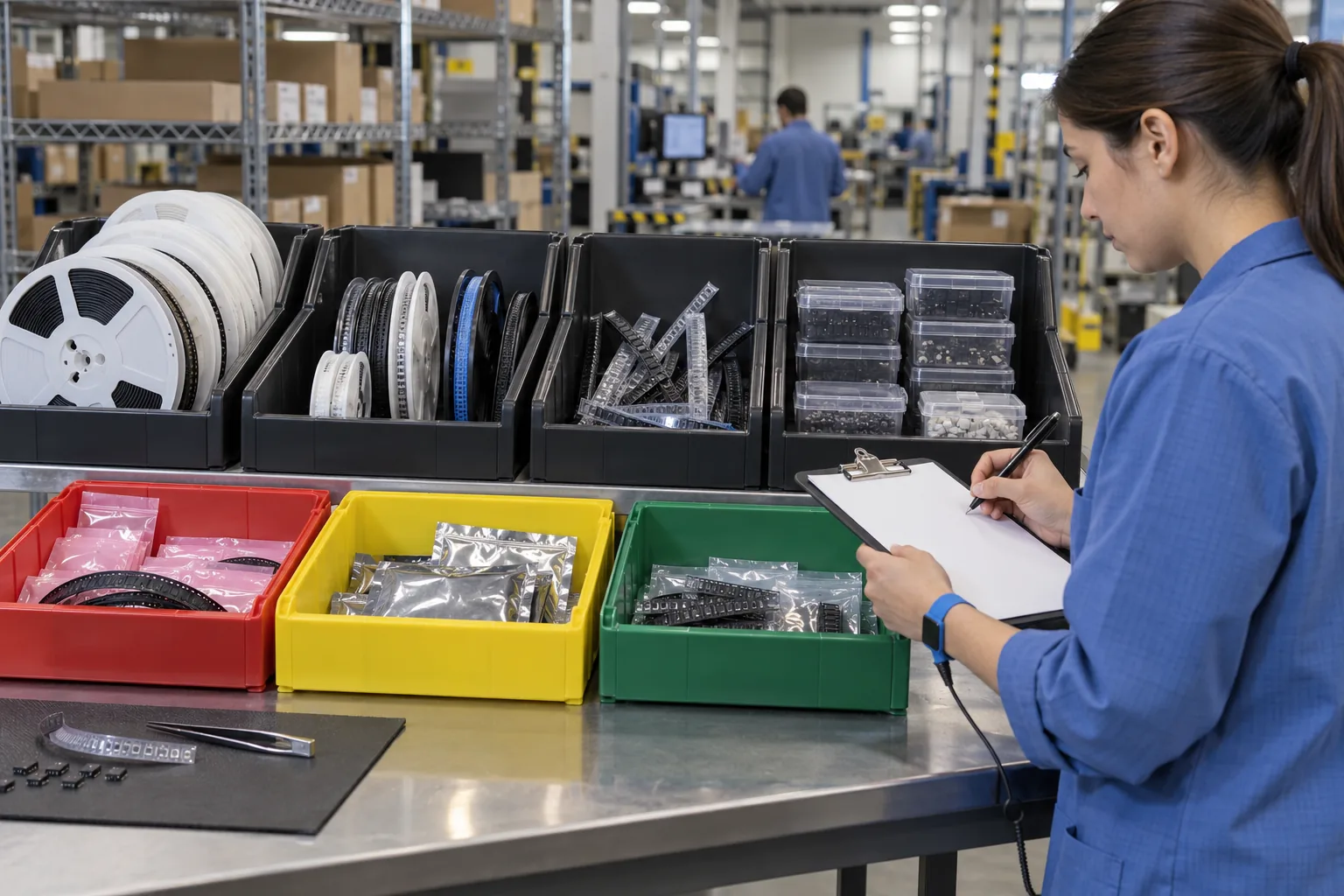
An alternate is not the same material merely because it fits the package. Link it to the released approval and keep its package, polarity and programming impact visible. A short kit can proceed only under an explicit build-quantity or partial-build decision; it should not become a surprise when the feeder reaches an empty pocket.
What can a copyable SMT material handoff checklist look like?
Use one line per material container, not only one line per BOM item. Multiple reels or strips of the same part can have different lots, counts, orientations and exposure histories.
Container line: Project/build [ ] | BOM line/reference range [ ] | Manufacturer and full MPN [ ] | Package/order suffix [ ] | Reel/tray/tube/cut tape [ ] | Container/label ID [ ] | Lot/date code as supplied [ ] | Required quantity [ ] | Received quantity [ ] | Usable verified quantity [ ] | Open/partial status [ ].
Feeding check: Tape width/pitch or tray/tube type if needed [ ] | Continuous strips and quantity per strip [ ] | Pocket/cover/sprocket condition [ ] | Leader/tail/splice condition [ ] | Manufacturer orientation source [ ] | Physical pin-one/polarity presentation [ ] | Planned feeder/transfer route [ ] | Setup owner/date [ ].
Difference line: Shortage / overage / mixed lot / loose part / damaged carrier / unclear label / substitute / surplus return [ ] | Affected quantity [ ] | Segregated location [ ] | Photo/reference [ ] | Authorization or next action [ ] | Owner/date [ ] | Final usable quantity [ ].
Use the separate moisture-sensitive component guide when an MSL label or opened dry pack adds an exposure decision. For a customer-supplied kit, connect the checklist to consigned PCB assembly; for the placement route, connect it to SMT assembly. The checklist does not claim a universal attrition allowance, minimum strip length, feeder compatibility or PCBArise-specific loading capability.
About the author
PCBArise Electronics
PCBArise Electronics publishes this guide to help design and NPI teams prepare clearer manufacturing files. The requirements for any actual build are confirmed from its current design package.
FAQ
Common questions
Is tape-and-reel packaging a higher component quality grade than tray or tube?+
No. Reel, tray, tube and cut tape describe delivery and handling formats. Component quality, authenticity, electrical grade and acceptance come from the exact orderable part, source, records and applicable inspection—not from the carrier shape.
Can any cut-tape strip be loaded directly into an SMT feeder?+
No. Direct loading depends on the feeder, carrier width and pitch, continuous usable pockets, intact sprocket holes and cover tape, plus enough starting material for that setup. Record the actual strip and loading plan instead of applying one universal minimum length.
What information should be kept with a partial reel or cut tape?+
Keep the manufacturer and full part number, BOM line, package, supplied lot/date information, container or source-reel link, verified usable quantity, orientation, open-pack or MSL status, strip continuity and any splice or damage.
Is component orientation in a reel the same as CPL rotation?+
No. Reel orientation states how pin one or polarity is presented in the carrier. CPL rotation describes how the part is placed on a PCB under a stated board-side and coordinate convention. NPI must map both through the verified package library and assembly drawing.
How should loose or mixed SMT components be handed off?+
Segregate them in suitable protective packaging, attach a traceable identity and count, and record why they are loose or mixed. Do not merge uncertain parts into a verified reel or tray. Unresolved identity, polarity, lot or handling history requires a hold.
How much extra component quantity should an SMT kit include?+
There is no universal percentage. Set the quantity from build placements, feeder and setup needs, package/carrier condition, inspection or programming losses, rework policy and the actual equipment route. Record the agreed allowance per BOM line rather than hiding it in a blanket factor.
Technical references
Sources used for this guide
These sources explain the standards, materials or process details discussed above. Check the current revision when applying them to a new design.
- Texas Instruments — full reel, custom reel, cut tape, tube and tray ordering formats
- Texas Instruments — part-specific carrier material lookup and pin-one data
- NXP — tape-and-reel construction and device-orientation guidance
- Microchip — part-family tape-and-reel orientation specifications
- Analog Devices — package resources for tape/reel, tube and tray information
- DigiKey — cut-tape continuity, leader/trailer and custom-reel context